

For three years, EdTech vendors got to sell into the easiest budget environment K-12 has seen in a generation. Districts had roughly $190 billion in emergency federal relief and a mandate to spend it fast. That era is over.
ESSER funds had to be fully liquidated by February 2026. McKinsey's school funding model now projects total K–12 funding to stay essentially flat in nominal terms — $969 billion in 2025–26, $972 billion in 2026–27 — which means a real-dollar decline once you account for inflation. In a recession scenario, McKinsey projects state funding could fall as much as 6.5% in 2026–27, a $29 billion hit that would look a lot like a second ESSER cliff on top of the first.
If your pitch still assumes districts have flexible dollars for a new pilot, it's time to rewrite it.
What Actually Happens When the Money Runs Out
Here's the part vendors underestimate: when districts have to cut, technology contracts are often first on the chopping block — not because they're ineffective, but because they're easier to cut than people. Marguerite Roza, director of Georgetown's Edunomics Lab, has pointed out that districts typically protect staff positions over vendor contracts, even when the vendor tool might deliver a better outcome for students. It's simply an easier political and administrative decision.
That single fact should change how every EdTech company frames its value. A tool that competes with a program a district already loves is vulnerable. A tool that's woven into daily operations, tied to a compliance requirement, or directly supporting a metric the superintendent is accountable for is far harder to cut.
Industry conversation at 2026's EdExec Summit captured this shift precisely: many EdTech companies have thousands of classrooms using their product but struggle to convert that into a sustainable, district-wide contract. The events call this "pilot purgatory," and the fix isn't a better demo — it's proof that your tool is essential enough to survive a budget review.
Every District Is Feeling This Differently
Not all districts are equally exposed. ESSER dollars were distributed using the same formula as Title I, which means high-poverty districts received more stimulus money — and now face a steeper drop when it disappears. Districts also vary by how much of their state and local funding cushions the loss; some states have raised local revenue or changed funding formulas to soften the blow, while others haven't.
Practically, this means a one-size-fits-all pitch about "affordability" misses the mark. A high-poverty urban district and a well-resourced suburban district are having very different budget conversations right now, even if they're both cutting technology spend.
The New Sales Question: "Why Can't You Cut This?"
Every superintendent and curriculum director is now running each existing contract through one filter: what happens if we don't renew this? EdTech vendors need an answer ready before that question is asked.
That answer usually comes down to a few things:
Utilization data. Tools with a documented track record of actual classroom use, not just licenses purchased, are easier to defend at budget time.
Third-party validation. Evidence, safety, usability, and interoperability credentials (the kind cataloged by resources like the EdTech Index) increasingly matter more than a slick sales deck.
Alignment to a non-negotiable priority. Tools tied to state-mandated instructional shifts, safety requirements, or reporting obligations are much harder to walk away from than general-purpose tools.
Outcomes tracking, not just usage tracking. Districts that connected ESSER-era investments to measurable student outcomes — rather than just spending the money — are the ones best positioned to justify continued investment now.
What This Means for Your Messaging This Year
The old EdTech pitch leaned on "look what this can do for your students." That's necessary, but it's no longer sufficient. The pitch that wins in a post-ESSER budget cycle answers a harder question: "why does this survive when everything else gets cut?"
That means your content, your case studies, and your sales conversations all need a sharper focus on retention, outcomes, and essentiality — not just capability.
How Holy Shack Digital Can Help
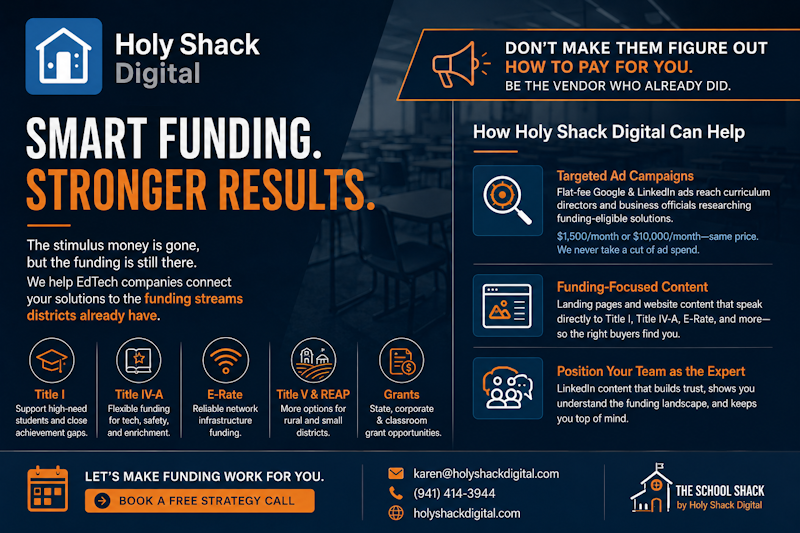
When budgets tighten, EdTech companies can't afford marketing spend that isn't accountable. That's why Holy Shack Digital's management fee stays fixed up to $40,000 in monthly ad spend — no matter how your Google, Meta, or LinkedIn budget scales to reach a smaller pool of serious buyers. Grow past that, and you simply move to the next fixed tier.
Through The School Shack, we also build:
Websites with a built-in lead dashboard and UTM tracking, so you can show your own leadership exactly which campaigns are producing pipeline in a budget-constrained buying environment.
LinkedIn content and outreach built around utilization proof and outcomes messaging — the exact case a curriculum director needs to defend your renewal.
📅 Book a free strategy call 📧 karen@holyshackdigital.com | (941) 414-3944 | holyshackdigital.com writing your post here…

Ready to Fill Your Calendar?
Book a free strategy call — we'll show you exactly how we'd run your ads and grow your business.