Most school district fiscal years just flipped over on July 1. If you sell into K-12, that single date resets everything: new budgets, new priorities, and a fresh procurement clock that most vendors misread every single year.
Here's the pattern we see over and over. EdTech companies pitch hardest in August and September, right when teachers are back and attention is nowhere near a purchase order. Meanwhile, the real buying decisions were already locked in months earlier, during a budget cycle most vendors never watch.
If you want the 2026–27 school year to be your best selling year yet, the calendar matters as much as the product.
How the District Budget Cycle Actually Works
School district budgeting isn't one event. It's a months-long process with a predictable shape, even though the exact dates vary by state and district:
Winter–early spring: Departments and building leaders draft budget requests. Curriculum directors and IT leaders build their technology wish lists here, based on what's expiring, what's underperforming, and what state or federal guidance is pushing them toward.
Spring: The superintendent presents a proposed budget to the school board or a budget committee. Public comment periods open. This is where priorities get trimmed.
Late spring–June: The board adopts a final budget, often just weeks before the new fiscal year starts.
July 1: The new fiscal year begins for most districts. Funds are now available, but purchasing decisions on major tools were usually shaped months earlier.
Fall: Implementation season. Districts spend on tools that support what's already been decided, not on brand-new initiatives.
The pattern shows up clearly in real district calendars. North Clackamas School District's budget process, for example, runs through building-based and central staff review, a budget committee, and public comment before board adoption — a sequence that plays out in some form in nearly every district nationwide.
The Best (and Worst) Windows to Pitch
Given that cycle, here's how the year breaks down for EdTech sales and marketing:
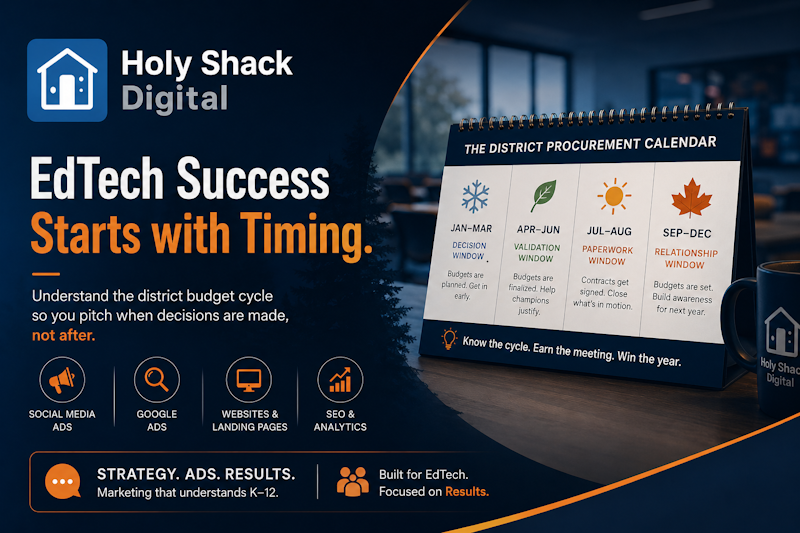
January–March: The real decision window. This is when curriculum directors and IT leaders are building next year's requests. If your product isn't in front of them now, it's not making it into the draft budget.
April–June: The validation window. Budgets are being finalized. This is a strong time for content that helps a champion justify a line item to their board — ROI data, compliance answers, and implementation timelines.
July–August: The paperwork window. Contracts get signed, POs get cut, and back-to-school prep begins. Good time to close deals that were already in motion. Poor time to start a brand-new relationship.
September–December: The relationship-building window. Budgets are locked for the year, but this is exactly when to build the awareness and trust that turns into a January conversation. Content, case studies, and low-pressure outreach do their best work here.
One recent industry read on this puts it well: as ESSER-era stimulus spending fades, districts are in what some vendors call "pilot purgatory" — lots of classroom footprints, not enough district-wide contracts — and the fix is treating the sales cycle as a year-round relationship rather than a fall sprint.
Cooperative Purchasing: The Side Door Into Procurement
There's a second path into district budgets that a lot of EdTech marketers overlook: cooperative purchasing contracts.
Organizations like Sourcewell, OMNIA Partners (which absorbed the National Cooperative Purchasing Alliance in 2022), and NASPO ValuePoint let a vendor win one competitively solicited master contract and then sell to thousands of member districts without each one running its own RFP. Sourcewell alone represents more than 50,000 government, education, and nonprofit member organizations. OMNIA's network covers more than 90,000 eligible agencies, including K-12 and higher ed.
For a vendor, this is a meaningful shortcut: instead of responding to individual district RFPs one at a time, a single cooperative contract award opens the door to a large pool of pre-qualified buyers. It's a slower path to get onto (competitive solicitations, lead-agency processes, evaluation scoring), but once you're on, it removes a major procurement barrier for every district that wants to use you.
What This Means for Your Marketing Calendar
If your content, ads, and outreach are all timed around back-to-school, you're marketing to an audience whose budget decisions are already made. The districts most receptive to a new tool in September are the ones who started the conversation with you back in the winter.
That doesn't mean stop marketing in the fall — it means shift what you're doing. Winter and spring are for education and demand generation. Summer is for closing. Fall and early winter are for relationship-building content that sets up your next winter pipeline.
How Holy Shack Digital Can Help
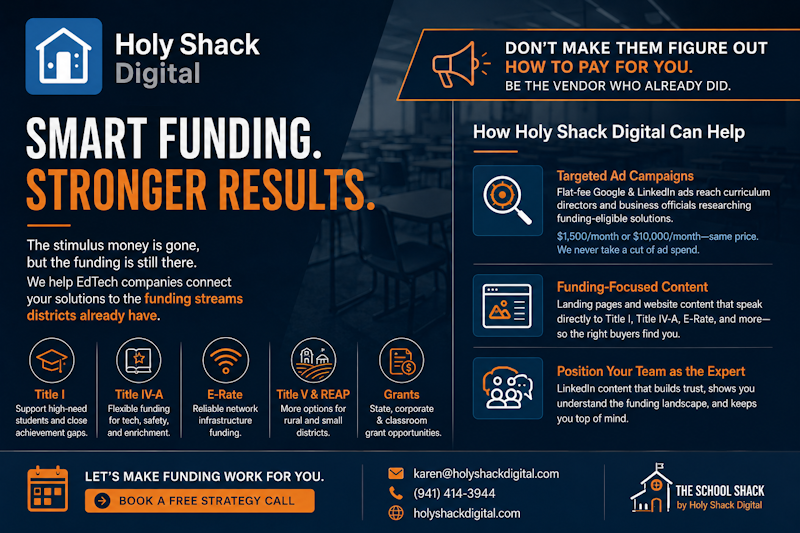
Timing a year-round EdTech sales cycle takes a marketing partner who's watching the calendar with you, not just running the same campaign every month. Through The School Shack, Holy Shack Digital builds:
Flat-fee Google, Meta, and LinkedIn ad campaigns timed to when curriculum directors and IT leaders are actually building their budgets — a flat fee up to a generous ad spend ceiling, not a shrinking cut of your budget as you grow.
A website and lead dashboard that tracks exactly when and where your leads come in, so you can see your own pipeline shift from awareness to decision to close across the year.
LinkedIn content calendars built around the district budget cycle, so your brand is already trusted by the time a curriculum director opens next year's requests.
📅 Book a free strategy call 📧 karen@holyshackdigital.com | (941) 414-3944 | holyshackdigital.com
Sources
Ready to Fill Your Calendar?
Book a free strategy call — we'll show you exactly how we'd run your ads and grow your business.