

There's a moment in EdTech marketing meetings I wish I could freeze-frame.
Someone pulls up the dashboard. Traffic is up. Click-through rates look great. Cost-per-click is down. Everyone nods. Then someone in sales quietly asks the only question that actually matters: "So how many demos did we book?"
Silence.
I spent years on the other side of that desk — not running the ads, but as the person school districts were actually buying from. And here's what I learned that most paid advertising in this industry still ignores: schools don't buy like businesses. Run EdTech ads on the standard B2B SaaS playbook and you'll get traffic. You'll rarely get pipeline.
The playbook that doesn't fit
Most paid media talent comes up through e-commerce or B2B SaaS. Those playbooks rest on a simple assumption: the person who wants the product can buy the product. Show the right ad to the right user, make the offer clear, cut the friction, close.
Education breaks that assumption on day one.
The user is almost never the buyer
In K-12, the teacher who falls in love with your tool is rarely the person who can purchase it. That decision climbs a ladder — department head, principal, curriculum director, technology director, sometimes the school board. Each one cares about something different.
The teacher cares whether it helps Monday morning. The administrator cares about student outcomes, equity, compliance, and whether they can defend the line item when the budget gets picked apart.
Speak only to the teacher's excitement and you generate enthusiasm that dies the second it reaches someone with signing authority. Speak only to the administrator and you lose the champion who drives adoption from the ground up. You need both — and you need to know which one you're talking to in every campaign.
Schools buy on a calendar, not on a whim
B2B SaaS runs on manufactured urgency: limited offer, act now, book today. Schools don't work that way. Purchasing is tied to budget cycles, fiscal years, grant windows, and committees that meet on their own schedule. An ad that converts beautifully in spring can be invisible in fall — not because the message got worse, but because the money simply isn't there yet.
The smartest EdTech advertisers align spend to how districts actually plan and buy: warming up champions early, then showing up unmistakably the moment budgets open.
The money got tighter
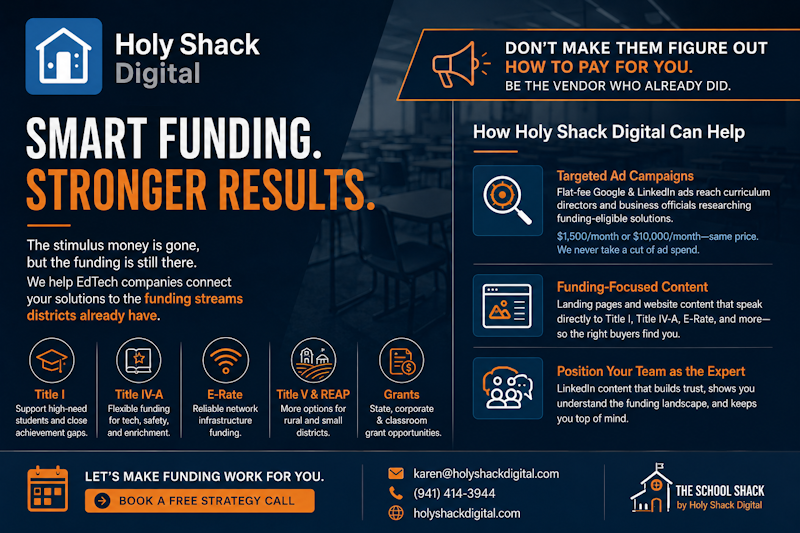
There's a financial reality reshaping this entire market. The federal pandemic relief that flooded schools with technology spending — ESSER — has run dry. The easy money is gone. Districts are scrutinizing every renewal and every new purchase, asking harder questions about outcomes and return.
For advertisers, that changes two things. Efficiency stops being optional — you can't paper over a leaky funnel with volume anymore. And your message has to justify the spend, not just spark interest. "Teachers love it" doesn't survive a budget committee. "Here's the measurable outcome, and here's how it pays for itself" does.
So what actually works
Target the decision-maker, nurture the champion. Build separate paths for the person who signs and the person who advocates. They need different messages.
Message to outcomes, not features. Administrators buy results they can defend to a board, not feature lists.
Respect the calendar. Time campaigns to budget and buying cycles instead of fighting them.
Build for the long game. Paid media feeds a months-long, multi-touch, committee-driven pipeline. It almost never closes a deal on its own — pair it with real nurture.
Pick channels by buyer, not by habit. LinkedIn reaches district and enterprise decision-makers. Google captures high-intent search when someone's actively looking. Meta builds awareness and reaches educators. Each plays a different role — using one for all of them wastes budget.
Measure pipeline, not vanity. Clicks and CTR are scoreboard noise. Track cost-per-demo, qualified pipeline, and closed deals — and fix your landing pages and conversion tracking before you scale a single dollar.
The bottom line
Paid advertising in EdTech isn't broken because the platforms don't work. It's broken because too many campaigns are built for a buyer who doesn't exist in education.
Fix the foundation — tracking, messaging, and the funnel. Speak to the real decision-maker. Respect how schools actually buy. Then scale.
Strategy. Relationships. Results. In that order.
I work with EdTech companies that are tired of ad spend that makes traffic but not pipeline. If that's you, let's talk — I'm taking on fractional and contract work.
Book a call: holyshackdigital.com/book
Ready to Fill Your Calendar?
Book a free strategy call — we'll show you exactly how we'd run your ads and grow your business.