
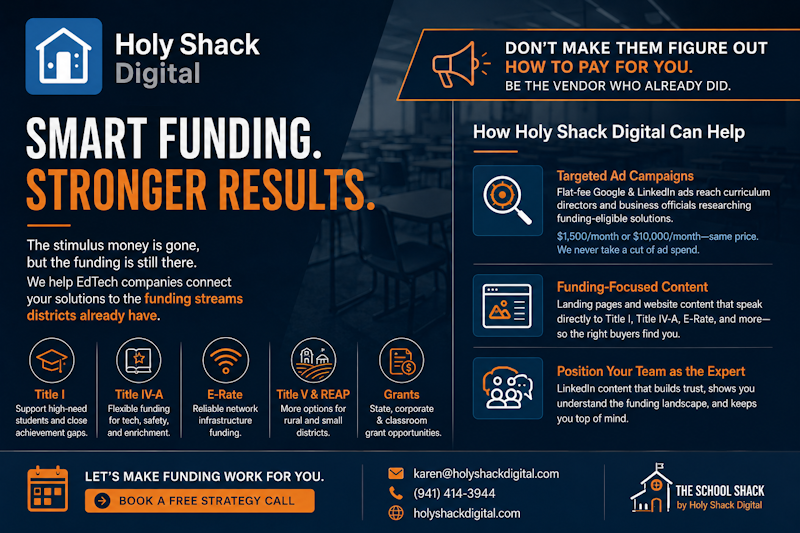
The stimulus money is gone, but school districts haven't stopped buying technology — they've just gone back to the funding streams that were always there. If your sales team can't speak fluently about Title I, Title IV-A, and E-Rate, you're leaving your buyer to figure out how to pay for you on their own. Don't make them do that work.
Here's what's actually available, and how to position your product against each one.
Title I: The Quiet Workhorse
Title I is designed to support schools with high concentrations of students from low-income families, and it remains one of the largest sources of discretionary federal dollars in K-12. Each state is required to direct at least 7% of its Title I funds toward interventions and technical assistance — a category that explicitly includes instructional software.
What this means for your pitch: If your product supports intervention, tutoring, or targeted academic support for struggling students, you're speaking directly to a funding stream your buyer already controls. Frame your ROI language around the specific outcomes Title I dollars are meant to produce — closing achievement gaps for high-need students — rather than generic "engagement."
Title IV-A: The Best-Kept Secret in EdTech Funding
The Student Support and Academic Enrichment program (Title IV, Part A) is one of the most flexible funding streams in the Every Student Succeeds Act. It's built around three allowable uses: a well-rounded education, safe and healthy students, and effective use of technology.
The catch: no more than 15% of a district's Title IV-A allocation can go toward technology infrastructure, devices, equipment, and software. That's still real money — Washington State alone received roughly $22 million in Title IV-A funds for the 2025–26 school year, distributed across all eligible districts — but it means your product needs a plan for how a district justifies you against that 15% cap.
What this means for your pitch: Products that clearly map to "effective use of technology" or "safe and healthy students" — think digital literacy tools, SEL platforms, or attendance and safety software — fit naturally here. Help your champion write the justification language before the budget meeting, not after.
E-Rate: Still the Backbone of Network Funding
E-Rate remains the cornerstone of school network funding, providing discounts on internet access and on-campus networking equipment like switches, routers, and wireless access points. Category Two funding specifically covers the infrastructure that distributes signal throughout a campus. Applicants must certify compliance with the Children's Internet Protection Act to participate.
What this means for your pitch: If your product depends on reliable bandwidth or new networking hardware to function well, E-Rate is the mechanism your buyer will use to fund the infrastructure underneath you — worth knowing so you can speak to it in a technical sales conversation with an IT director.
Title V and REAP: The Rural District Lifeline
Title V, and the related Rural Education Achievement Program (REAP), exist specifically for small and rural districts that often don't have the staff capacity to compete for standard federal grants. REAP dollars can be spent on anything allowable under Titles I-A, II-A, III, and IV-A — which means rural districts have more flexibility than their formulas alone would suggest.
What this means for your pitch: Don't assume small, rural districts are locked out of your price point. Many have access to blended funding pools that a larger, better-resourced district can't touch.
State and Corporate Grants: The Long Tail
Beyond federal formula funding, there's a wide field of state-specific and corporate grant programs actively funding classroom technology right now:
Free searchable databases like GetEdFunding, GrantsAlert, and GrantWatch track active K-12 technology grants by category.
Crowdfunding-style platforms — DonorsChoose, Digital Wish, AdoptAClassroom — let individual teachers fund smaller purchases directly.
Corporate programs including the Toshiba America Foundation, Samsung Solve for Tomorrow, AFCEA Educational Foundation, and Verizon Foundation fund STEM and digital-access initiatives year-round.
States are running their own targeted programs too — California, for example, set aside $200 million for ELA/ELD-aligned professional development and $50 million specifically to train math coaches for the 2025–26 school year, both of which shape which vendors get added to state-approved lists.
What this means for your pitch: A sales team that can point a prospect toward a specific, relevant grant — even one you don't directly benefit from — builds trust fast. It signals you understand their budget reality instead of just wanting a check cut from it.
The Real Opportunity: Be the Vendor Who Already Did the Homework
Every one of these funding sources comes with paperwork, deadlines, and eligibility rules that most curriculum directors don't have time to fully research. The EdTech companies that win in this environment aren't necessarily the ones with the best product — they're the ones who make the funding conversation easy.
How Holy Shack Digital Can Help
Funding-source messaging only works if it reaches the right person at the right budget moment — which is exactly why timing and targeting matter as much as the message itself.
Through The School Shack, Holy Shack Digital builds:
Flat-fee Google and LinkedIn ad campaigns targeted at curriculum directors and business officials researching Title I, Title IV-A, and E-Rate-eligible purchases — priced the same whether your budget is $1,500/month or $10,000/month, since we never take a cut of ad spend.
Landing pages and website content that speak directly to specific funding sources, so a prospect researching "Title IV-A eligible edtech" lands on a page built for exactly that search.
LinkedIn content that positions your team as the vendor who already understands the funding landscape — before a competitor gets the chance to.
📅 Book a free strategy call 📧 karen@holyshackdigital.com | (941) 414-3944 | holyshackdigital.com


Ready to Fill Your Calendar?
Book a free strategy call — we'll show you exactly how we'd run your ads and grow your business.