Follow the money, and the edtech market is telling a clear story right now: capital has decided where it wants to go, and it's not where it went during the pandemic boom.
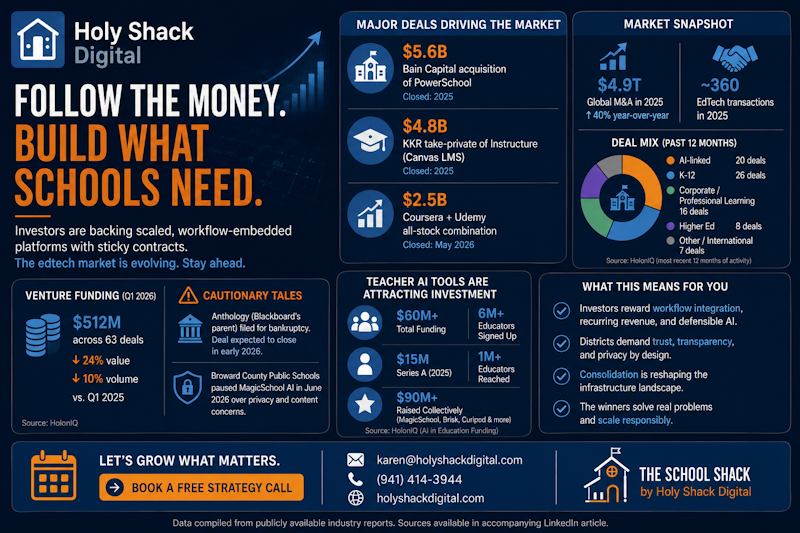
Three deals anchor the current cycle. Bain Capital's $5.6 billion acquisition of PowerSchool. KKR's $4.8 billion take-private of Instructure, the company behind the Canvas learning management system — the single largest edtech deal in years at the time. And the $2.5 billion all-stock combination of Coursera and Udemy, which closed in May 2026. All three are proof points for the same thesis: investors want scaled, workflow-embedded learning platforms with sticky enterprise contracts, not flashy consumer growth stories.
The Volume Story: Steady, Not Booming
Global M&A overall rebounded 40% in 2025 to $4.9 trillion — the second-highest annual deal value on record — and EdTech rode that wave. HolonIQ counted roughly 360 EdTech transactions in 2025. But look at the more recent window and the picture gets more measured: across the most recent 12 months tracked, deal volume was essentially flat year-over-year (62 deals versus 61 the year before), even though headline dollar totals stayed strong at roughly $5.3 billion disclosed.
The composition of those deals is the real signal. Of the most recent 12 months of activity, roughly 20 were AI-linked, 26 were K-12-linked, 16 were corporate or professional learning deals, and the rest split across higher ed and international markets. Translation: this isn't broad-based exuberance. It's targeted buying in specific categories investors believe are durable.
Not Every Story Is a Winner
Two cautionary tales sit alongside the marquee deals. Anthology, the parent company of Blackboard, filed for bankruptcy, with a deal expected to complete in early 2026. And venture funding into pure-play AI-in-education startups actually cooled in early 2026 — HolonIQ tracked EdTech venture funding at $512 million across 63 deals in Q1 2026, down 24% in value and 10% in volume compared to Q1 2025.
Meanwhile, McGraw Hill completed a $415 million IPO, a notable bet that public markets still have appetite for a scaled, traditional content and curriculum company — a different kind of proof point than the AI-native startups grabbing most of the headlines.
Where the AI Money Is Actually Going
Within the AI-in-education funding data specifically, teacher-facing tools have quietly become one of the strongest sub-categories. MagicSchool AI, the AI platform for K-12 educators, grew from a $2.4 million seed round in 2023 to more than $60 million in total funding, with more than 6 million educators signed up. Brisk Teaching raised a $15 million Series A led by Bessemer in 2025 after reaching over 1 million educators and partnering with more than 2,000 schools and districts. Collectively, teacher-focused AI tools — MagicSchool, Brisk, Curipod, and others — have raised more than $90 million.
But scale hasn't insulated these companies from district-level scrutiny. Broward County Public Schools paused its use of MagicSchool AI in June 2026 over privacy and content concerns — a reminder that "teachers signed up" and "board-approved district contract" are two very different milestones, and the gap between them is exactly where a lot of AI tools are currently stuck.
What This Means If You're Building or Marketing an EdTech Product
If you're raising capital: Investors are rewarding workflow-embedded products with recurring revenue and defensible AI roadmaps — not raw user growth. If your pitch leans heavily on sign-up numbers rather than paid, renewed district contracts, expect harder questions than you'd have gotten in 2021.
If you're marketing to districts: The Broward pause is a preview of a broader trend. As more AI tools reach real classroom scale, expect more districts to formalize review processes mid-contract, not just at initial procurement. Building trust and transparency into your product now is cheaper than managing a public pause later.
If you're evaluating competitors or partners: The consolidation happening around PowerSchool, Instructure, and Anthology means the vendor landscape districts rely on for core infrastructure (SIS, LMS) is increasingly owned by private equity. That has real implications for how those platforms price, prioritize integrations, and treat smaller partners — worth factoring into your own product roadmap if you build on top of any of them.
How Holy Shack Digital Can Help
Whether you're raising your next round or defending a renewal, the story investors and districts hear about your company should be the same one your marketing tells every day. Through The School Shack, Holy Shack Digital builds:
Websites with real lead and pipeline data — the kind of concrete, documented traction (not just sign-up counts) that matters to investors and to your own board.
LinkedIn content that positions your company inside the trends investors are actually funding right now: workflow integration, defensible AI use, and district-level trust.
Flat-fee paid ad management across Google, Meta, and LinkedIn, so your customer acquisition costs stay predictable and defensible in board conversations, unlike agencies charging a percentage of your growing ad spend.
📅 Book a free strategy call 📧 karen@holyshackdigital.com | (941) 414-3944 | holyshackdigital.com
Sources

Ready to Fill Your Calendar?
Book a free strategy call — we'll show you exactly how we'd run your ads and grow your business.