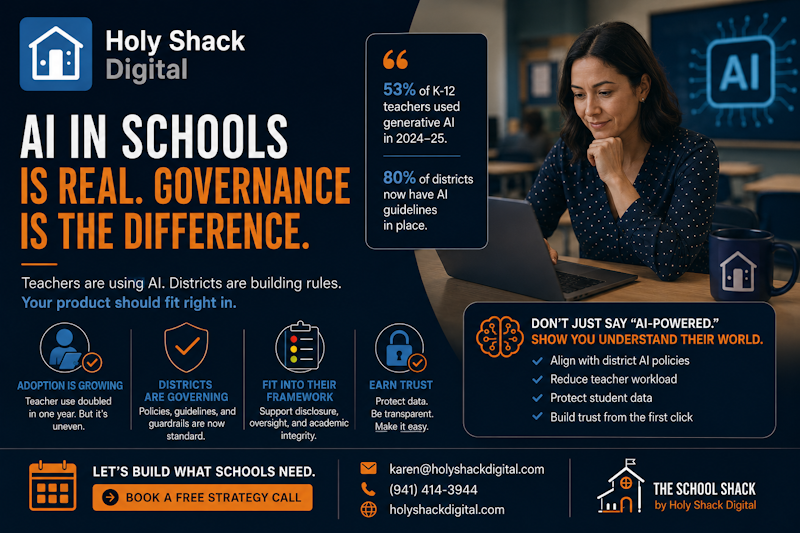
Here's the number that should reset every AI pitch deck in EdTech: the share of K-12 teachers using generative AI for their work doubled in a single school year — from 25% in 2023-24 to 53% in 2024-25, according to RAND's national survey data. That's one of the fastest adoption curves education technology has ever seen.
But the more useful number for anyone selling into schools right now is this one: nearly 80% of K-12 technology leaders say they now have AI guidelines in place, according to CoSN's 2026 district survey. AI in schools has moved past the experimentation phase and into governance. If your pitch doesn't account for that, you're a year behind your buyer.
Adoption Is Real, But It's Deeply Uneven
The RAND data tells a more complicated story than "AI adoption is up." Teachers in higher-poverty schools are consistently less likely to use AI tools than their counterparts in lower-resourced districts, and principals in high-poverty schools report providing AI guidance to their staff less often. English language arts and science teachers were nearly twice as likely to use AI tools as math teachers or elementary generalists — likely because ELA and science teachers already build and adapt more of their own instructional materials, so AI slots naturally into a workflow that already exists.
Pre-K teachers lag furthest behind: only 29% used generative AI in 2024-25, compared to 53% across K-12 overall, even though more than 80% of pre-K teachers agree that technology could help with instructional planning, administrative work, and family communication. The gap isn't about interest — it's about training, comfort, and appropriate use cases for the youngest learners.
Why this matters for your pitch: A generic "AI saves teachers time" message will land very differently in a well-resourced suburban high school than in an under-resourced elementary school. If your ideal customer profile spans both, you need two different messages, not one.
Districts Are Writing Their Own Rules — And They're More Sophisticated Than You'd Expect
At the 2026 CoSN Annual Conference, IT leaders shared real examples of how they're building AI governance without waiting for a state mandate. Alexandria City Public Schools in Virginia deliberately chose not to write a standalone AI policy. Instead, they folded AI guidance into their existing academic honesty and acceptable-use policies, built around principles of human-centered design, data privacy, transparency, and continuous improvement.
Niles Township High School District 219 in Illinois built something more visual: a stoplight framework using the image of Rodin's "The Thinker" to signal, assignment by assignment, whether AI use is prohibited (red), allowed with disclosure (yellow), or required (green, for assignments specifically designed to need AI assistance).
Why this matters for your pitch: Districts aren't looking for vendors to tell them whether AI is good or bad. They're looking for products that plug cleanly into governance frameworks they've already built or are actively building. A product that makes disclosure, citation, and teacher oversight easy is speaking the district's language. A product that just promises "more AI" isn't.
The Real Opportunity Is in Content Creation, Not Just Tutoring
One data point worth noting for anyone building product marketing: some of the clearest recent evidence of AI's leverage in EdTech isn't in student-facing tutoring — it's in content production economics. One major language-learning platform's Q1 2026 shareholder letter reported publishing over 20,000 language course units in a single quarter, compared to roughly 7,100 per quarter in 2025 and 1,800 per quarter in 2024. That's not a claim about better learning outcomes — it's a demonstration of how dramatically AI can compress the cost and time of building and iterating instructional content at scale.
Why this matters for your pitch: If your AI story is only about the student or teacher-facing experience, you may be underselling your own operational advantage. Districts and investors alike are increasingly interested in how AI changes what a vendor can build and iterate, not just what a chatbot can answer.
What to Say Instead of "Powered by AI"
Buyers are numb to "AI-powered" as a headline. What actually earns attention from a curriculum director or CTO in 2026:
Specifics about how the product handles disclosure and academic integrity, since governance frameworks like the stoplight model are becoming common.
Evidence that the product works for teachers who are AI-hesitant, not just AI-enthusiastic early adopters — a real gap given the training disparities RAND has documented.
A clear answer to "what data does this touch, and how," since AI features raise the data-privacy stakes covered in COPPA's 2026 compliance deadline.
How Holy Shack Digital Can Help
AI messaging needs to be specific to land with a buyer who's already fielding a dozen "AI-powered" pitches a week. Through The School Shack, Holy Shack Digital builds:
Website and landing page copy that replaces generic AI claims with governance-aware, teacher-specific messaging that matches how districts are actually evaluating AI tools right now.
LinkedIn content series built to reach the CTOs and curriculum directors writing AI policy today, positioning your product as one that fits inside a governance framework instead of fighting it.
AI automation training and consulting for your own team, so your internal workflows reflect the same responsible, transparent AI use you're marketing to schools.
📅 Book a free strategy call 📧 karen@holyshackdigital.com | (941) 414-3944 | holyshackdigital.com
Sources
Ready to Fill Your Calendar?
Book a free strategy call — we'll show you exactly how we'd run your ads and grow your business.